

Lower Back Pain
A clear guide to lower back pain: causes, common symptoms, when to see a doctor and how chiropractic care may help.
On this page
- What is lower back pain?
- What are the symptoms of lower back pain?
- What are the complications of lower back pain?
- What are the common causes of lower back pain?
- Do I need to see a doctor for lower back pain?
- How can I relieve lower back pain at home?
- What are the treatments for lower back pain?
- Is chiropractic care good for lower back pain?
Quick answer
Lower back pain usually comes from strained muscles, ligaments, joints or discs, often linked to posture and everyday movement. For many people with this kind of mechanical back pain, chiropractic care, including spinal adjustments, may help relieve pain and improve movement. See a doctor promptly if back pain follows a fall or comes with fever or leg weakness, and straight away if you have numbness in the groin area or bladder or bowel problems.
What is lower back pain?
Lower back pain is one of the most common types of pain. It usually comes from muscles, ligaments, joints or discs being twisted or overstretched, often by sudden movements combined with everyday posture and lifestyle habits.
Chronic back pain can stop you doing the things you enjoy. Seek care if it is reducing your mobility or making daily tasks harder.
Lower Back Pain facts
- Lower back pain is one of the most common types of pain.
- Acute lower back pain can become chronic if it lasts 12 weeks or more.
- Long periods of sitting or standing put pressure on lower back muscles and discs.
What are the symptoms of lower back pain?
Symptoms depend on the cause and severity. Common signs include:
- Pain ranging from a dull ache to a sharp, stabbing pain, constant or on and off
- Muscle tightness or spasms
- Difficulty moving, bending or twisting
- Pain spreading into the buttocks, legs or feet, as with sciatica, when a lower spine nerve root is compressed
- Numbness, tingling or weakness in the legs or feet
- Tenderness when touched
- Pain that worsens with long sitting or standing and eases when you recline
Signs of a more serious problem
- Difficulty passing urine, or loss of bladder or bowel control
- Severe, constant pain that does not improve with rest
- Unexplained weight loss or fever with back pain
- Pain after a fall or accident
- New back pain with a history of cancer
If you have any of these signs, see a doctor promptly.
What are the complications of lower back pain?
If not addressed in time, lower back pain can affect your physical and mental well-being and lead to:
- Chronic pain: acute pain can become chronic if it lasts 12 weeks or more
- Physical deconditioning: less activity can lead to weaker muscles, stiffness and lower fitness
- Difficulty with everyday tasks such as lifting, bending and sitting
- Nerve symptoms (radiculopathy) such as numbness, tingling or leg weakness from a herniated disc or spinal stenosis
- Low mood, anxiety and poor sleep, which can make pain feel worse
- Time off work and higher medical costs
- Side effects or dependency from long-term use of some pain medicines
- Risks from invasive treatments such as surgery, which does not always bring full relief
A care plan combining therapy, pain management and lifestyle changes may help reduce these risks.
What are the common causes of lower back pain?
Lower back pain often has more than one cause. Common causes include:
- Injury: a sudden strain or tear in the muscles and ligaments that support the back
- Overwork: muscles used repeatedly without enough rest, causing weakness and then pain
- Poor posture: long periods in an incorrect position stress the spine and muscles
- Inactivity: a weak, stiff back is more prone to pain and injury
- Bulging or ruptured discs pressing on nearby nerves
- Degenerative disc disease, where worn discs cushion the spine less well
- Arthritis, which can narrow the space around the spinal cord (spinal stenosis)
- Scoliosis, a sideways curve of the spine
- Osteoporosis, where brittle bones can lead to compression fractures
Your job, smoking and body weight can also affect your risk.
Do I need to see a doctor for lower back pain?
Lower back pain from a minor strain often settles on its own. See a doctor if:
- The pain lasts more than a few weeks despite rest, ice and pain relief
- The pain is severe or does not improve with rest
- Pain spreads down one or both legs, especially below the knee, which may be sciatica
- You have weakness, numbness or tingling in one or both legs
- You have unexplained weight loss, or a fever with back pain
- The pain started after an accident or fall
See a doctor straight away if you have difficulty controlling your bladder or bowels. This can be a sign of cauda equina syndrome, a serious condition needing immediate attention.
How can I relieve lower back pain at home?
These simple steps may help ease lower back pain and support your mobility:
- Rest: avoid working too hard for too long, take breaks, eat well and sleep enough
- Exercise: stay active with a mix of strength, cardio and stretching
- Posture: set up your desk, chair, car seat and bed to support a neutral position
- Mindfulness: deep breathing, meditation and muscle relaxation can ease tension
- Shoes: choose supportive, comfortable shoes rather than high heels or hard soles
- Weight: a healthy weight reduces strain on the back
If pain persists or is severe, see a healthcare professional.
What are the treatments for lower back pain?
Treatment depends on the cause and severity, and often combines several approaches:
- Chiropractic care: spinal adjustments may help some people with lower back pain
- Rest and activity changes: a short rest for a strain, then a gradual return to activity; long bed rest is generally discouraged
- Physical therapy: exercises and stretches for flexibility, strength and posture
- Pain relief: paracetamol or ibuprofen, or stronger medicines prescribed by a doctor
- Heat or cold packs to ease pain and inflammation
- Corticosteroid injections, given by a doctor for more severe cases
- Other therapies, such as acupuncture or massage
- Regular low-impact exercise and strength training to support the spine
Is chiropractic care good for lower back pain?
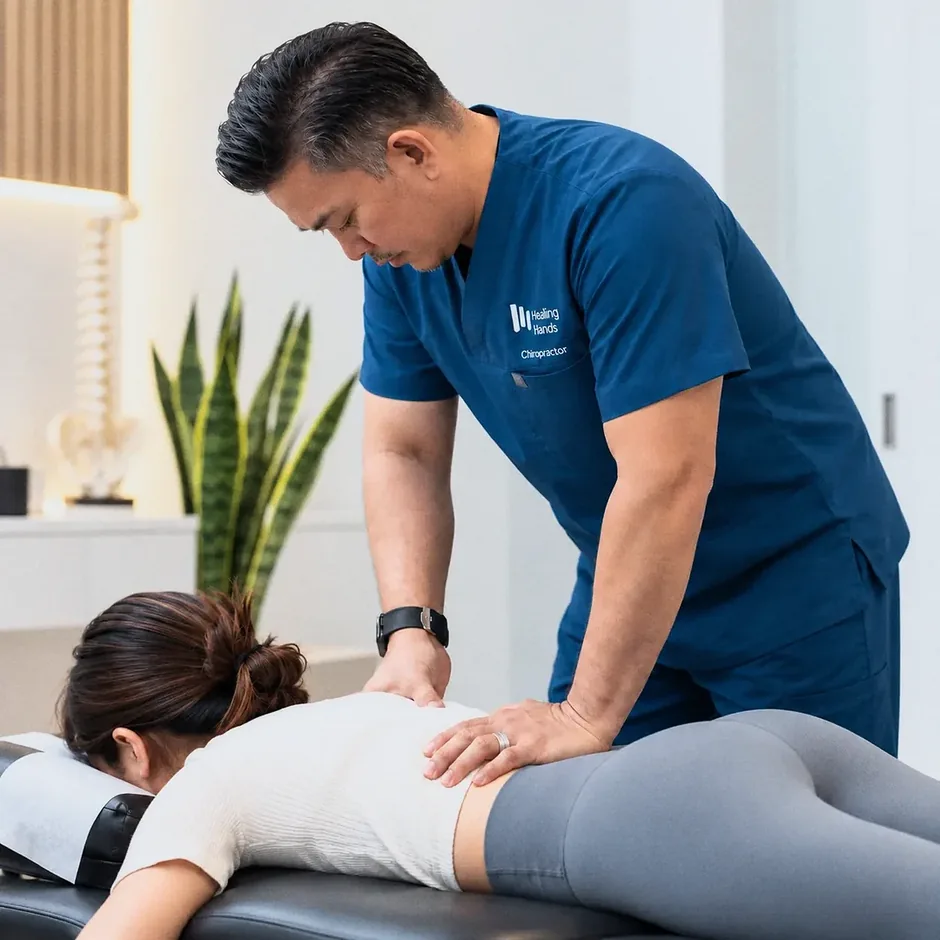
Many people with lower back pain turn to chiropractic care. Research suggests spinal adjustments may be as helpful as other conventional treatments for some people with acute or chronic lower back pain. Chiropractic care is drug-free, can work alongside physical therapy, massage or medication, and often includes posture, ergonomics and lifestyle advice.
At Healing Hands Wellness Cambodia, your first visit includes an AI posture analysis, a Walker View gait analysis and a one-to-one consultation to check whether adjustments suit you. If they do, your chiropractor may adjust your spine over several sessions, supported by therapy such as the flexion-distraction table (FDT), E-stim or ultrasound, and show you exercises for mobility and flexibility.
If you are pregnant, care is adapted for pregnancy; check with your obstetrician or doctor first.
Why Healing Hands
Why choose Healing Hands Wellness?
Healing Hands Wellness Cambodia brings the Healing Hands approach to chiropractic care to our clinic in Phnom Penh, open every day.
Your first visit starts with an AI posture analysis, a Walker View gait analysis and a one-to-one consultation with a chiropractor, so your care plan is based on what we find. Our chiropractors use non-invasive techniques and explain each step before treatment.
Not sure what is causing your pain? Start with an assessment.
Your first visit includes an AI posture analysis, a Walker View gait analysis, a consultation with a chiropractor, an adjustment where suitable and supporting therapy, for US$68.
Your first visit
What to expect at your first visit.
Here is what happens at your first appointment, so you know what to expect before you arrive.
01
AI posture & gait analysis
Our AI posture analysis checks your posture from head to hips, and the Walker View gait analysis measures how you walk and share your weight. It is quick and painless.
02
Consultation
A one-to-one chat with your chiropractor about your health history, what you are feeling and what you would like to get back to doing.
03
Physical assessment
Simple movement and range-of-motion tests show how your body is moving today, so your chiropractor can decide whether an adjustment is right for you.
04
Chiropractic adjustment
If it is clinically safe, your chiropractor makes gentle, controlled adjustments by hand. A “pop” sound is normal; it is just gas being released from the joint.
05
Supporting therapy
E-stim, ultrasound or the flexion-distraction table (FDT) to help relax muscles and support your recovery.
Good to know
Questions,
answered.
Can’t find what you’re looking for? Message us and our team will happily help.
Should I rest in bed with lower back pain?
A short rest can help with a muscle strain, but long periods of bed rest are generally discouraged. Gradually returning to normal activity, while avoiding heavy lifting and twisting, can support recovery.
Can chiropractic care help lower back pain?
For many people with mechanical back pain, spinal adjustments may help relieve pain and improve movement. Your chiropractor will first check whether adjustments are suitable for you.
Is chiropractic treatment painful?
Adjustments are generally painless. If an injury is recent, muscles may feel tender for a short time. A popping sound is normal; it is gas being released from the joint.
What happens at my first visit?
Your first visit is US$68 and includes an AI posture analysis, a Walker View gait analysis, a one-to-one consultation with the chiropractor, an adjustment where clinically suitable, and supporting therapy such as E-stim, ultrasound or the flexion-distraction table (FDT).
Conditions
Other conditions we help with
Our clinic in Phnom Penh
Find us in
Phnom Penh.
Visit our clinic in Phnom Penh, open every day, near home, near work or on your commute.
Address
No. 5 Wat Koh St (St. 81), 4th Floor, Phnom Penh 12211, Cambodia
Opening hours
Mon – Fri: 8:30 am – 1 pm, 2 – 6 pm
Sat – Sun: 8:30 am – 5 pm
Phone
Book your visit
Request an
appointment.
Tell us how to reach you and when suits you, and our team will be in touch to confirm your appointment.
- Personalised care across all services
- Open every day
- Quick appointment confirmation